
KIRIBAKU: AN ANALYSIS OF THE RELATIONSHIP BETWEEN EIJIRO KIRISHIMA AND BAKUGOU KATSUKI.
TABLE OF CONTENTS
Abstract
Introduction: Horikoshi’s History of LGBTQ+ Friendly Writing
Chapters
Canonically Gay Characters vs. Bromances
Bakugou’s Baseline and Capacity for Affection
Childhood
Parental Relationships
Bakugou and Izuku
The Bakusquad
His Journey of Self Discovery
Kirishima’s Gay Coding
The History of Queer Coding and Queer Baiting
Kirishima’s Gay Coding
The Timeline and Implications
Meeting
Friendship
Something More?
Conclusion
Bibliography
ABSTRACT
Kirishima and Bakugou make sense as a couple because if they were a standard Male/Female pairing, there wouldn’t be any question about their ability to be each other’s romantic interests.
INTRODUCTION
Historically, Shonen animes have shied away from having prominent characters that are part of the LGBTQ+ community due to their demographic of consumers. However, Horikoshi has begun to push the boundaries of what may or may not be standard for characters in Shonen anime, including characters that are bisexual, and transgender.
The most obvious characters represented are Magne and Tiger. Magne was a transgender woman who was a part of the League of Villains until her death by Overhaul. When discussing a possible alliance with Overhaul and his team, Toga and Twice even defend her when she gets misgendered. Tiger is a transgender male who is a part of the Wild, Wild Pussycats; this is not explicitly explained in the story (because it is not important for moving the plot forward) but is canon. Toga is the representative bisexual character in the show, being in love with both Ochako and Izuku.
It is not completely unheard of to have LGBTQ+ characters in Shonen animes, however they are typically used as the butt of the joke or created to be wild caricatures. The important distinction between the standard representation of LGBTQ+ characters in Shonen animes and those in My Hero Academia is the fact that each of these characters is treated like an actual character with importance and story outside of their identity.
CHAPTER 1
CANONICALLY GAY COUPLES VS BROMANCES
Bromance: A close but non-sexual relationship between two men, a form of homosocial intimacy.
The media world is riddled with bromances and often, individuals who do not want to entertain the idea that characters might be queer, will use the term “bromance” to explain away potential burgeoning gay relationships. Now, just to be clear, just because two people are close or portrayed as being good friends, does not necessarily indicate that the couple is automatically queer. However, if you were to witness the same scene happening between a man and a woman, and your first thought would be that they are going to be romantic interests, it might be queer.
For example:
Victor and Yuri (Yuri On Ice) - Canonically Queer
Hug and suspected kiss on the ice after Yuri’s performance.
The cursory touches and extended looks.
Exchanging rings.
If this was a man and a woman? They would absolutely be pegged as romantic interests.

Slightly more convoluted:
Historia and Ymir (Attack on Titan) - Unconfirmed
Longing looks.
Staying by each other’s sides no matter what.
The love letter from Ymir to Historia declaring that her only regret was not being able to marry Historia.
People argue that the only thing the letter proves is that Ymir was in love with Historia and not that the feelings were necessarily reciprocated. However, if this were a straight pairing and a letter like that dropped? There would be no doubt in the readers and watchers’ minds that the author intended for them to be romantic interests for each other.

Unconfirmed, but come on:
Reki and Langa (Sk8 the Infinity) - Unconfirmed
Langa admitting to his mother that he has feelings for someone and responding confusedly when she assumes it is a female.
The lingering touches and looks.
Reki pulling Langa out of his downward spiral in the final match against Adam because he makes Langa’s heart race.
Again, nothing is blatantly confirmed, but if the same exact interactions were to unfold between a man and a woman, it would only be a matter of time before readers expected them to become confirmed romantic interests.

Keep this idea and these examples in mind as we switch gears to the primary focus of this dissertation, the relationship between Eijiro Kirishima and Katsuki Bakugou.
CHAPTER 2
BAKUGOU’S BASELINE AND CAPACITY FOR AFFECTION
Childhood
To understand Bakugou Katsuki, it is important to first understand his childhood. From the very beginning of the series, it is made very clear that Bakugou considers himself to be the very best and puts everyone else below him, especially Izuku. In Book 11, Chapter 96, Katsuki’s mother, Mitsuki is quoted saying “his whole life, people’ve made a fuss about him, praising him for every little thing he does.”

Katsuki’s Praise (Book 2, Chapter 9, Page 35)
Again, later in the series, Izuku mentions that it was when Katsuki’s quirk manifested that things really started to go downhill for their relationship. This was likely a result of Katsuki’s ego growing.

Turning the Tables (Book 2, Chapter 9, Page 26)
Parental Relationships
Katsuki’s relationship with his parents is a hot topic of debate within the MHA community. The only interactions we see with Katsuki and his mother are in Book 11, Chapter 96 when Aizawa starts making home visits to get permission for the students to stay in the dorms and periodically her voice gets featured in panels telling him to stop yelling. The primary interaction that has garnered a lot of attention is the one in Book 11, Chapter 96. Mitsuki is seen smacking Bakugou and saying, “SHUT IT YOU LITTLE PUNK! SINCE YOU’RE SUCH A WEAK LITTLE BITCH AND GOT KIDNAPPED, YOU CAUSED EVERYONE ALL SORTS OF TROUBLE.”

Home Visits, Anime Version (Episode 50)
There are quite a few things to unpack here with this interaction. The first and most obvious would be Mitsuki hitting Bakugou, in Japan, corporal punishment for children is still considered to be more culturally accepted. Specifically, a survey taken in December of 2019 revealed that “70% of Japanese adults believe that corporal punishment is necessary” (Rogers, K). That being said, there have also been multiple studies that have shown that hitting children can cause a myriad of emotional and mental health issues in the long run and can be permanently damaging. One specific study from 2016 (April 28, 2016 - Update on What Happens When You Hit Your Kids: Fifty years of research involving over 160,000 children shows unequivocally that spanking is not only ineffective as a form of discipline but is detrimental to the mental health of children and adults.) specifically found that since parents are physically bigger and stronger than their children with greater capability of greater self-control, “When a parent tries to get children to behave better by hitting them, that parent is telling them that hitting people who are smaller and weaker than you is an acceptable way of getting what you want from them” (Ma, L). This would explain a lot about Bakugou’s behavior and how much of a bully he was as a child.
It is absolutely an inference that this is not the first time that Mitsuki has hit her son, however, given the fact that she’s comfortable doing it in front of his teachers and the volatile nature of their relationship, it is likely that this is a semi-regular occurrence. This would explain Katsuki’s tendency for violence growing up as additional studies show that “corporal punishment is part of a larger pattern of societal acceptance of violence” (Lansford, J.E.). Then, just to put the nail in the coffin, additional studies have shown that physical punishment (spanking, hitting, and causing pain) “can lead to aggression, antisocial behavior, physical injury and mental health problems for children” (Smith, B. L.).
The next bit in that interaction to unpack is the “such a weak little bitch” comment. Time and time again, Katsuki has exhibited his desire to be the best hero, the strongest, someone who can save others and does not need anyone else to save him. In fact, one of his biggest issues with Izuku is the fact that despite being a weak, quirkless loser, he still insists on trying to help Bakugou.
Finally, the “you caused everyone all sorts of trouble” comment. It is clear that Katsuki blames himself for ending All Might’s career despite everyone telling him otherwise. In Chapter 121 he makes it clear to Izuku and All Might that he feels responsible for what happened and breaks down in tears. It is possible that he would have internalized everything he went through as weakness due to his upbringing, but it is also possible that what his mother said to him that day got into his head. Putting blame on him for something traumatic that wasn’t his fault, like being kidnapped falls into the category of victim blaming. “You got kidnapped because you were too weak to stop it.”
Bakugou and Izuku
Izuku and Bakugou’s relationship is incredibly complicated and to fully and completely analyze it would require an entire paper of its own. So, for the sake of remaining on topic, this section will remain moderately surface level.
Bakugou and Izuku grew up together and are shown to have been friends until Bakugou developed his quirk. As mentioned earlier, their relationship really began to go downhill once Katsuki got it in his head that he was better than Izuku. Given the pressures Katsuki felt and continues to feel throughout most of the series thus far, the idea that someone weaker than him could offer him any type of assistance or surpass him would immediately mean that he is weaker than he thinks, which is something he cannot abide.
Some examples of this manifesting appear when Izuku rushes down to the river to help when Katsuki falls in and when Katsuki realizes how strong Deku has become.


Katsuki lashes out in anger towards Deku, not because he truly hates him, but because he fears him. He fears what it would mean if the person he considers to be weak becomes stronger than him; in his mind, this wouldn’t be a success on the part of Izuku but rather a failure on his. When Bakugou’s anger gets the better of him at the sports festival, it is for no other reason than he thinks that Todoroki, someone he considers to be legitimate competition, does not consider him worthy enough to fight against him full force. Almost certainly, it wouldn’t have been such a big deal had Shoto not used his flames against Izuku in the fight prior.
Bakugou even admits to All Might, and later in the series, Izuku himself that the reason he bullied Izuku so much as a kid was due to his own insecurities.


It’s only after truly losing Izuku and doing some serious reflection that Katsuki really comes to terms with how he truly feels about his childhood friend and himself.
The Bakusquad
It could be argued all day long whether or not Katsuki would have seen the error of his ways and reconciled with Izuku eventually without exterior motivators. However, what is true is that Katsuki did not start his journey to self reflection and change until he let Kirishima into his life, and subsequently Sero Hanta, Mina Ashido, and Denki Kaminari, collectively known by the fandom as the “Bakusquad”. He is clearly closest to Kirishima, however his relationships with the squad are a catalyst for him to open up to things that he would have otherwise pushed aside.

His Journey of Self Discovery
Something else that has been a topic of debate among the My Hero Academia community is the extent of Bakugou’s “trauma” even outside the relationship he has with his mother. So, for the sake of unbiased analysis, I will not be offering my opinion during this section, instead laying out all the evidence and stating facts.
On the way home from middle school, Katsuki is attacked by a Sludge Villain which covers his mouth and nose, suffocating him.
When Katsuki wins the sports festival, he is angry about how he won and does not want to accept the award. In response, he is restrained, muzzled and chained to the podium.
Katsuki is kidnapped, being dragged by his neck by Dabi into Kurogiri’s portal.
Katsuki is restrained to a chair, surrounded by the League of Villains inside their hideout.
After being rescued by some of Class 1-A including Izuku and Kirishima, Katsuki watches All Might fight and lose his power.
Katsuki admits that he blames himself and his kidnapping for All Might’s retirement.
During the joint training with Class 1-B, Katsuki exhibits unprecedented teamwork and leadership.
Katsuki begins to assist Izuku in his mastery of Black Whip, joining All Might and Izuku in some of their private meetings and even admits to All Might that he bullied Deku as a child because he was afraid of his own weakness.
During the war, when it looks as though Deku is going to get hit by All for One’s tendrils, Katsuki pushes him out of the way, getting impaled instead.
Katsuki leads the confrontation of Endeavor to convince him to bring Izuku back to U.A.
Katsuki apologizes to Izuku and catches him as he falls into his arms.
Whether or not you agree that some of these events were traumatic for Bakugou, all of them were impactful moments in his character development. Being saved by Deku from the Sludge Villain played to his insecurities, focusing on the fact that his quirkless, childhood friend saved him when he could do nothing to save himself. Depending on how you interpret the sports festival scene, it was either another hit to Katsuki’s ego only playing up his own self doubt and complexes, a traumatic remembering of the Sludge Villain attack given the restrictions, or both. Then, the cherry on top comes when he is kidnapped and restrained yet again in the League of Villains’ hideout.
It is clear that each of these events were impactful in Katsuki’s life, each infuriating him by making him feel powerless when his entire life has been built around becoming the most powerful. He is so determined to reach his goal of becoming number one, but each of these events makes him feel weak, which is everything that he despises.
Being rescued is the first pivotal point in Bakugou’s character development, transitioning from being hateful and afraid to accepting and open to developing relationships in his life. The second major breaking point for Katsuki was the fight at Ground Beta when he finally admits to Izuku that he blames himself and his self proclaimed weakness for All Might’s retirement.

After All Might comforts him and explains that he would have lost his powers regardless, Katsuki seems to begin on his, albeit slow, path to self discovery.
During the joint training arc, Bakugou goes out of his way to work on his teamwork, determined to become the best hero he can be. Then, after Black Whip appears, Katsuki takes it upon himself to help Izuku work out how to use it and even joins in on the meetings with All Might and Izuku talking about One for All. The most drastic internal change occurs when Katsuki saves Izuku from All for One’s tendrils. This self-sacrifice is both an incredible leap forward in his journey to becoming an amazing hero and calls back to all the times that Izuku has put himself in harms way for people he cares about. In this way, Katsuki is becoming more open to the relationships in his life and realizing that not everything is about him. Just because someone else is becoming stronger, doesn’t mean he is getting weaker. Just because his path is different, doesn’t mean it’s wrong. And just because someone is strong, that doesn’t mean that they don’t need help every now and then.
The final piece of his transition and growth in the series thus far is shown when he leads the crusade in looking for Izuku and apologizes for everything he’s done. This apology is important for several reasons. First, it is the first time that Bakugou ever admits to Izuku that he was wrong. Second, it provides a conclusion to the tumultuous ride that Katsuki has been on, battling his emotions and finally accepting that he has them and needs to face them.
CHAPTER 3
KIRISHIMA’S GAY CODING
The History of Queer Coding and Queer Baiting
Queer coding is defined as “when characters may not be explicitly stated to be queer, but there is enough subtext available for an audience to read them as queer. Instead of explicitly being queer, they are coded as being queer” (Jaigirdar, A.). It is generally considered a neutral tool writers use to create subtext to hint at queerness, however it is not something that exists exclusively in the fictional space. Historically, queer individuals were not always safe enough to be externally queer in public and because of this, the queer community has crafted subtle and quiet ways to hint to one another that they are part of the LGBTQ+ community. Whether this is through the dress, coded language, or just an overall feeling someone may exude, all of these have been subtle indications that a person or character is queer. Additionally, in the 1930’s films were not allowed to “portray ‘perverse’ subjects such as homosexuality, which inevitably led to the portrayal of non-explicit queer characters. The trend of the inclusivity of queer characters in a subtexual way likely bled into modern portrayal of queer characters” (Wikimedia Foundation.)
Some famous examples of queer coded characters in mainstream media include “Shego from Kim Possible, Ursula from The Little Mermaid, HIM from Power Puff Girls, and James from Pokemon” (Harris, A.). These characters that became queer icons are fantastic examples of an author giving a character “traits or behaviors that suggest their queerness without any outright confirmation.”
Queer coding in male characters often looks like a character taking pride in their appearance, proclaiming good taste, having a flair for the dramatic, and may be more interested in a certain male character than anyone else. One place you might be able to find a queer coded male character is in the “Gay Best Friend” spot. This type of queer coded male is typically the “reliable, flamboyant, and easily manipulated male attached to the hip of a more palatable female main character” (Medina, H.). The second obvious place you might find this queer coded male is in the role of the “Second in Command”, this character is typically attached at the hip to a strong, stereotypically manly character as their more fruity sidekick. An excellent example of this type of relationship can be seen in Beauty in the Beast with Gaston and Le Fou. While it was expressed more clearly in the 2017 film, the queer coding of the character was pretty subtextual in the original 1991 movie.
On the other hand, queer coding in female characters tends to look more like the rejection of femininity and the embracing of tomboy-esque styles and isms. “Queer Coded female characters are also often pitted against the stereotypical female main characters. This opposition is similar to the hyper-masculine versus effeminate dichotomy in male relationships” (Medina, H.). Excellent examples of the queer coded female in media include: Janice in Mean Girls, Ymir and Historia from Attack on Titan, and Elsa from Frozen.
Consequently since audiences have been deprived of LGBTQ+ representation for such a long time, queer audiences love and celebrate queer characters and shows that have the courage to openly write in such characters. Unfortunately this is where a major issue pops up, and that is queerbaiting. The Take, a Youtube Channel defines queerbaiting as “implying characters queerness or hinting at a future queer romance in an attempt to secure a queer audience without delivering anything explicitly enough to alienate homophobic audiences.” This results in tricking underrepresented communities into supporting them without truly giving them the representation they want or deserve.
Anime, particularly sports anime, are notorious for queerbaiting and are quite possibly one of the worst offenders out there. These anime will often result in intense shipping communities that boost the audience past what it would normally get without the queerbaiting. Free, Haikyuu!!, Wave! Let’s Go Surfing, and Ouran High School Host Club are excellent examples of shows with an uncalled for amount of queerbaiting.
More recently, Sk8 the Infinity, a skateboarding anime, has been the talk of the anime community about whether or not it is queerbaiting. A majority of the characters are clearly queer coded and the relationship between Langa and Reki walks that line between friends and romantic partners very carefully and could be labeled as queerbaiting but could just as easily fit into the category of two young LGBTQ+ teenagers figuring out their identities and what they mean to each other. Considering that the series is not over yet and we are expecting a second season however, only time will truly tell.
Kirishima’s Gay Coding
Kirishima’s sexuality has not yet been confirmed, however there are a significant number of indicators that suggest he was written in a gay-coded fashion. The first and arguably most obvious indicator is his obsession with manly things. In the third book, Kirishima has a feature page that states his favorite things to be “hard-liners and tough guys”; this is interesting for a couple of reasons.

Favorite Things (Book 3, Page 26)
Firstly, the kanji used “Kouha” references a “faction of students who were showing their "toughness" by wearing the more casual, rough, and traditionally Japanese bushi style of clothing, compared to Nanpa who were dandies affecting an elegant, European-style fashion and enjoyed courting girls.” (https://en.wikipedia.org/wiki/Kouha) This obsession with men and all things manly is where the Japanese stereotype for gay men comes from. It is no secret that Kirishima is overly interested in manly things and by extension, manly men, like Bakugou. So, while based on the American stereotype of gay men, Aoyama is the best bet with his effeminate nature, in Japanese culture, Kirishima is actually the most gay-coded character in 1-A.
Kirishima’s interest and homage to the hero Crimson Riot also falls into this category of interest in manliness. Something that Crimson Riot says in an interview in chapter 145 resonates strongly with Kirishima and stays with him as he grows. “As long as you’ve got a manly spirit, then anybody and everybody can be a hero.” This resonates him so strongly that he ends up deciding on his hero name in homage to him; Red Riot. Crimson Riot is the first person to tell him that it’s okay to be afraid, but it’s what you do with that fear that makes you a hero.

The next reason that Kirishima’s interest in tough guys is notable is Mineta’s profile. Mineta is known to be one of the perviest, lady-obsessed characters in the show and in his favorites category, there is only one interest and that is girls.

Considering that none of the other characters have either gender in their likes, this is a pretty significant parallel.

So Manly (Book 3, Chapter 23)

Super Manly (Book 4, Chapter 32)
On top of all of this, Kirishima’s general disinterest in women speaks volumes. In Chapter 98, during the room share sub-arc, all of the guys were competing to see which room the girls would like the most but Kirishima blatantly didn’t care.


I thought long and hard about whether or not to include scenes from the movies and Smash because they are not technically canon. However, they are approved by Horokoshi and therefore still hold some weight in terms of being on-brand. In Smash, there is an ongoing theme that Kirishima is in love with Bakugou. The following are some examples of the interactions between Kirishima and Bakugou in Smash:
Example 1: Kirishima’s General Disinterest in Women, Seeking out Bakugou Instead

Example 2: Kirishima and Bakugou Performing Together

Example 3: Flirting to See Who Falls First

Example 4: Kirishima Realizing He’s the Only Partner for Bakugou

Example 5: Spending a Romantic Holiday Together


In addition, Horokoshi seems to always coordinate Bakugou and Kirishima’s outfits in the official art. Some of these examples can be found here:
Example 1: Casual Touching

Example 2: Depicted Together

Example 3: Matching Red Bandanas

Example 4: Kirishima is Bakugou’s Dragon in the Fantasy Art

Example 5: Sharing Clothes

Finally, the final piece of evidence that falls into the category of less than canon is their interactions in the movie “Two Heroes”. When Katsuki is invited to attend the I-Island Expo, Kirishima tags along as his plus one and they stay in a room together. In the depiction of the room it looks like there’s only one bed but that is not confirmed one way or another. Additionally, Kirishima brings them matching suits and gets away with physically holding Bakugou back when they are walking through the hotel together.
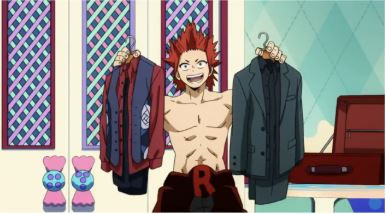

The combination of all these elements builds a compelling argument not only for the gay coding of the character but also the potential intentions of Horokoshi writing Kirishima this way. Then, by extension, implications about how Horikoshi continues to choose to portray Kirishima and Bakugou’s relationship.
CHAPTER 4
THE TIMELINE AND IMPLICATIONS
Meeting
From the beginning it is clear that Kirishima has a great admiration for the explosive student. In Book 2, Chapter 13, Page 115, as Kirishima talks to Midoriya about how he wishes that his quirk were “less boring”, it is already clear that he looks up to and admires what he would consider to be manly quirks. Before knowing anything about them as people, he immediately picks out Todoroki and Bakugou as people with what he would consider “strong and cool” quirks.
After this, in Book 2, Chapter 14, Page 137 as the villains are attacking the USJ, Kirishima and Bakugou simultaneously jump into action against Kurogiri who is blocking the escape for the students indicating that they are at least on the same wavelength, which is pretty impressive for Bakugou. Additionally, after attacking, instead of proclaiming that he would take down the villain himself, which is more on brand for Katsuki, he remains silent as Kirishima says “not if we end you first.” This indicates that at some level at least Bakugou considers Kirishima as someone worthy to be on his level and speak for him because as we see later in the series, he very rarely allows others to speak for him even in the throws of combat.
Next in Book 2, Chapter 17 as everyone gets separated, Kirishima and Bakugou make quick work of the villains in their sector indicating teamwork early on. Additionally on page 191 Bakugou puts aside his typical self-focused language instead stating that “If all they’re sending against us are these idiots, we should be fine.” Then as Bakugou is about to head out in search of Kurogiri, Kirishima tells him to wait for him saying “You gotta trust your pals…! Be a man Bakugou!” This is important because Bakugou does not correct him for suggesting they are friends. As shown later in the manga and the anime, if someone refers to Bakugou as a friend and he does not feel the same way he immediately retorts it, as shown in his interactions with Todoroki after the remedial classes.
Even this early on, Bakugou is seen to be taking criticism from Kirishima, in Book 3, Chapter 19, Page 30 Bakugou threatens Kurogiri “If I decide you’re doing anything fishy… I’ll blow you straight to kingdom come.” To which Kirishima responds “That’s not very heroic like dude…” Not only does Kirishima feel comfortable enough to make that observation to Bakugou but Bakugou does not snap back in return.
Later, during the sports festival Kirishima is seen to be staying close to Bakugou from the beginning. In Book 3, Chapter 24, Page 131 Kirishima checks in with Bakugou as they’re entering the arena regarding the praise they are receiving. Then in the same chapter on page 134 as everyone else seems pissed and upset that Bakugou declares that he plans on winning, Kirishima just seems shook.
Friends
I would argue that Kirishima and Bakugou’s friendship begins during the horse competition during the sports festival. While everyone is trying to pair up with Bakugou, the only person he really gives the time of day is Kirishima. In Book 4, Chapter 27, Page 13 Kirishima comes forward wanting to pair up with Bakugou and through the crowd of people that Bakugou doesn’t recognize or remember, he recognizes Kirishima from their previous interactions, “Ah, weird-hair.” To which Kirishima responds “The name’s Kirishima! Remember it!!” Kirishima already knows Bakugou’s personality well enough to know exactly what to say to him to convince him to be on his team. “I know you wanna be a rider, right?! So your front horse had better be someone who can take all those explosions, yeah? Who might that be?! … Nope!! It’s me with my “hardening”!! We’ll be the horse that can’t crumple! And we’ll definitely get those points, right?! Midoriya’s ten million…!” (Figure 1)

Figure 1
The truly pivotal point in their relationship from becoming classmates to friends is after Monoma taunts Bakugou about being the sludge villain’s victim. Book 4, Chapter 28, Page 43 Bakugou calls Kirishima by name, “Kirishima… Plan’s changed.” This is significant because not only does it indicate that he remembers his name, which is something Bakugou struggles with for the rest of his classmates throughout the series, but also that he has enough respect for him to include him on his new plan. Then again in Book 4, Chapter 29, Page 47 Bakugou calls Kirishima by his name again. “Keep moving, Kirishima! I’m as cool as ice!” In the same book Chapter 30, Page 74 Bakugou unintentionally underlines the importance of remembering Kirishima’s name and using it by calling his other teammates “Soy Sauce Face” and “ Racoon Eyes” despite their protests.
During the sparring rounds of the Sports Festival we really begin to see Bakugou’s respect for Kirishima come through. During their fight in Book 5, Chapter 41, Page 112 Bakugou comments on Kirishima and how he’s going all out during their fight being as determined as he could be. “Not even fazed… He’s more than just “hard”. This mutual respect for one another is an aspect of their relationship that continues throughout the rest of the series and sets their relationship and interactions apart from Bakugou’s relationships with his other classmates. Additionally, while Kirishima is kind and friendly to everyone (except Monoma) his gravitation towards Bakugou and his genuine like and respect for him as a friend stands out among his relationships.
In Book 6, Chapter 45, it’s Kirishima who notices that Todoroki and Bakugou’s agency offers are backwards to what they should have been based on the results of the sports festival and he seems genuinely confused why that might be. Later, in Book 7 while Momo plans on tutoring some of the individuals getting lower grades in the class Kirishima mentions “That’s what virtue looks like.” Spurring Bakugou on to respond, “I’ve got virtue too. I’ll tutor you ‘til you’re dead.” (Chapter 60, Page 132) As far as we can tell, Bakugou never tutors anyone except for Kirishima, providing another piece of proof for the special nature of their friendship.
Finally in Book 8, Chapter 68, Page 121 the gang decides they all want to go shopping. Everyone seems excited to go except for Bakugou, when Kirishima asks “Hey, you come too, Bakugou!” Bakugou responds with “No way in hell! What a waste of time.” However, despite this response, he is seen later on tagging along on the shopping trip. This implies that at some point between panels, Kirishima convinced him to come along.
Something More?
I believe that I and most other KiriBaku shippers would argue a couple of things when it comes to the relationship between Bakugou and Kirishima and about how it has been developing.
1. Kirishima realized his feelings first; and
2. That realization happened sometime between when Bakugou was kidnapped and when the team rescued him.
The first indication that Kirishima may like Bakugou as more than just friends comes in Book 9, Chapter 78 on Page 139. (Figure 2)

Figure 2
Of course everyone is concerned at the sudden announcement but Kirishima truly looks as though he is in pain. In Book 10, Chapter 82, Page 25 (flashing back to when everyone had just heard the announcement telepathically) Kirishima begs Vlad to let him go after Bakugou. “They’re after our friend! Please let us go out there!!” Despite other students such as Ida attempting to reason with him to stay safe Kirishima is persistent. “Aizawa sensei himself told us to fight!!” Then after Dabi bursts into the room on Page 28, while everyone is understandably upset, Kirishima’s only concern, again, is Bakugou. (Figure 3)

Figure 3
In the aftermath of the kidnapping, as everyone visits Deku in the hospital, Kirishima is the one who suggests rescuing Bakugou and not just soon, immediately. (Book 10, Chapter 83, Page 58) And when his fellow classmates try to talk him out of it, once again just like during the kidnapping, he is adamant. Even though he knows its not his place to interfere, he feels as though he has to. (Book 10, Chapter 83, Pages 61-63)
“You think I don’t know that?! But still! I couldn’t do anything! When I heard that they were after my buddy… I couldn’t do anything!! I didn’t do anything!! If I don’t act now… forget being a hero, I’m not even a man!!”

Even after extending the invitation to Midoriya to help with the rescue it becomes abundantly clear that he plans on going no matter what when he says “I’m not sure if you can even move in your condition, but you’re still welcome to join us…” (Book 10, Chapter 84, Page 72) Then on the bus ride with everyone in the rescue mission Kirishima once again reaffirms his faith in his friend by saying that he wouldn’t be doing any of this if he weren’t completely sure that Bakugou would accept the rescue and not turn to the villain side. (Book 10, Chapter 85, Page 91) Building up to the pivotal point of his rescue Kirishima is determined to rescue Bakugou at any cost, willing to barge right in when they pull up (Figure 4, Book 10, Chapter 85, Page 93) and even purchasing expensive night vision goggles to increase their chance at victory with whatever money he had as a high schooler (Figure 5, Book 10, Chapter 87, Page 131).

Figure 4

Figure 5
The really important part of this rescue exchange is perfectly summed up by the most analytical person and Katsuki expert in the group, Izuku Midoriya. In Book 11, Chapter 90, Pages 21-24 he makes it absolutely clear that nobody else other than Kirishima could be the person to call out to his friend, that Katsuki considers him an equal and that’s a huge deal for him.
“It has to be you Kirishima. You’re the key to our success here… It’s up to you Kirishima. It can’t be me. It can’t be Todoroki or Ida or Yayorozu either… Ever since we started school… You’ve been building a rapport with Kacchan. You’ll be calling out to him as a friend!!”
This declaration along with Kirishima’s surprise as he realizes how important he has become in Bakugou’s life is the turning point in their relationship. Not only the fact that the person who knows Bakugou better than anyone else is telling him this, but the fact that it works is huge. Bakugou has never accepted help prior to this moment from anyone even when it meant that he would have things harder, he even chastises All Might for rescuing him initially but the fact that he takes Kirishima’s hand indicates a shift in the dynamic that is both symbolic and extremely important.


While I believe that this is the moment that Kirishima begins to realize his feelings for his friend have changed, given everything mentioned in the first section of this dissertation, I do not believe that it meant the same thing to him, at least in that moment. Understanding that at least at some subconscious level, Kirishima let Bakugou go on with his excuse that they were just the best option he had at the moment. (Book 11, Chapter 92, Page 47)
It is from this point that Bakugou begins letting Kirishima get away with things that he wouldn’t let any other characters get away with, for example:
Apologize on his behalf.

Follow him around and call him names.
Criticize him.

Witness him in a moment of failure.

He even goes so far to encourage him when he’s feeling bad about himself; comparing him to All Might, the person he holds in higher regard than anyone else.


In conclusion, while there has been no confirmation from Horikoshi or the other writers about the sexuality of either Kirishima nor Bakugou, it would be reasonable to come to the conclusion that at the very least, they have feelings for each other. The artists and writers of the series have been known to play at this in Smash, official art, and through Izuku’s notes on the pair throughout the books, so it is clearly something that the team is at least aware of. Given that Horikoshi has canonically LGBTQ+ characters in the story already, in Magne, Tiger, and Toga it also wouldn’t be that much of a stretch to have an LGBTQ+ couple in the future. That being said, there has never been a mainstream Shonen anime with a prominent gay couple due to the culture surrounding the LGBTQ+ community in Japan.
All that said, I believe that if Horikoshi were to make the choice to further Kirishima and Bakugou’s relationship, it would make sense and feel like a natural progression of their current relationship. Kirishima is the healthiest relationship that Katsuki has and his friendship helps open the door to Katsuki building his other friendships and relationships.
Circling back to the first section of this paper, I will ask the question: if this were a heterosexual couple, would it make sense for them to be romantic interests? Given all of the reasons above and my own personal opinion based on years of anime and manga consumption, I believe that the answer is yes.
Bibliography
Harris, A. (2020, September 29). What are Queer coding and QUEERBAITING?: Her Campus. Her Campus | HerCampus.com is the #1 global community for college women, written entirely by the nation's top college journalists from 380+ campus chapters around the world. https://www.hercampus.com/school/utah/what-are-queer-coding-and-queerbaiting/.
Jaigirdar, A. (2021, July 13). What is QUEERBAITING vs QUEER CODING? BOOK RIOT. https://bookriot.com/what-is-queerbaiting-vs-queer-coding/.
Lansford, J. E. (2021, January 27). Hitting a child: The damage, and how a mother's warmth worsen the impact. Child and Family Blog.
Ma, L. (2014, September 19). This is what happens when you hit your kids. Psychology Today. https://www.psychologytoday.com/us/blog/good-thinking/201409/is-what-happens-when-you-hit-your-kids.
Medina, H. (2021, June 9). Queer coding in television and film : Yes your favorite villain is gay. What's Trending. https://whatstrending.com/queercoding-in-television-and-film/.
Rogers, K. (2020, January 1). Survey reveals 70% of Japanese adults BELIEVE corporal punishment is necessary. Japan Today. https://japantoday.com/category/national/survey-reveals-70-of-japanese-adults-believe-corporal-punishment-is-necessary.
Smith, B. L. (2012, April). The case against spanking. Monitor on Psychology. https://www.apa.org/monitor/2012/04/spanking#:~:text=Many%20studies%20have%20shown%20that,mental%20health%20problems%20for%20children.
Wikimedia Foundation. (2021, July 28). Queer coding. Wikipedia. https://en.wikipedia.org/wiki/Queer_coding.


Comments